
Organ Failure Is a Supply Problem
Pig organs already work in people. Now we have to make them last.
Everyone assumes your organs wear out and then you die. Much of modern medicine is built around that assumption: whole specialties exist to slow the failure of organs nobody can replace.
But it is only an assumption.
When a kidney, heart, liver, or lung stops working, there is no good way to fix or replace it. The only source of replacements today is people who die with organs that still work. Each of those organs has to become available at the right time, in the right place, and be compatible with the person who needs it.
Supply is severely limited. More than 35 million American adults have chronic kidney disease. More than 800,000 are living with kidney failure, on dialysis or with a transplant. About 95,000 are currently waiting for a kidney.
Most of them do not need a new drug. They need a new organ.
In 2024, surgeons at Massachusetts General Hospital transplanted a gene-edited pig kidney into a living patient for the first time. The longest one since has worked for about nine months before its function declined and it had to be removed.
Human organs are donated. A pig organ can be made, grown in an animal whose genes have been edited so the organ can work in a human body.
And because it can be made, it can be designed.
Durability is now the limit. More gene edits can make a pig organ last longer, and AI models of biology can speed up the search for the right ones.
If durability can be engineered, organ supply no longer depends on chance. It becomes something we design, improve, and scale.
A world with enough durable organs, where a failing organ becomes something you replace instead of something you die of, deserves a name.
We call it Organ Abundance.
The supply problem is a search problem
The best gene-edited pig kidneys in living people now work for months, not minutes or days. Finding the right gene edits will make them last longer, and durable organs are what unlock supply.
A handful of edits has already cleared what was once the biggest barrier. Humans carry natural antibodies against sugars on the surface of pig cells. Removing the genes behind the three major sugar targets, and adding human genes that help the organ regulate complement, clotting, and inflammation, is what lets these organs last as long as they now do.
What comes next is harder.
A pig organ differs from its human host at thousands of molecular points. Some differences matter, but many probably do not. Some can be safely edited, while others are essential to how the organ works. And the organ must still coexist with the human immune system for years.
Whatever incompatibility cannot be engineered away must be controlled in the recipient, usually with immunosuppressive drugs, which bring problems of their own.
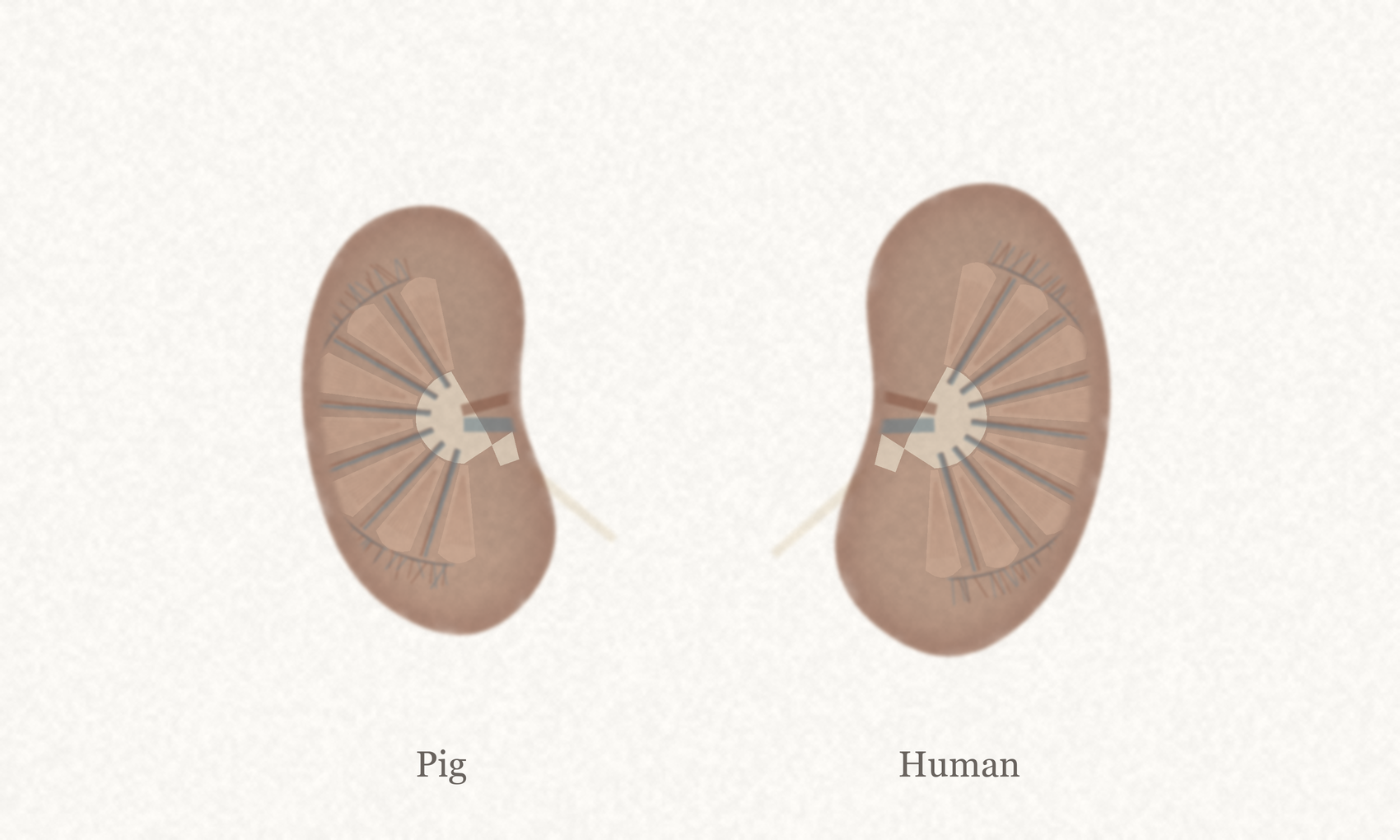
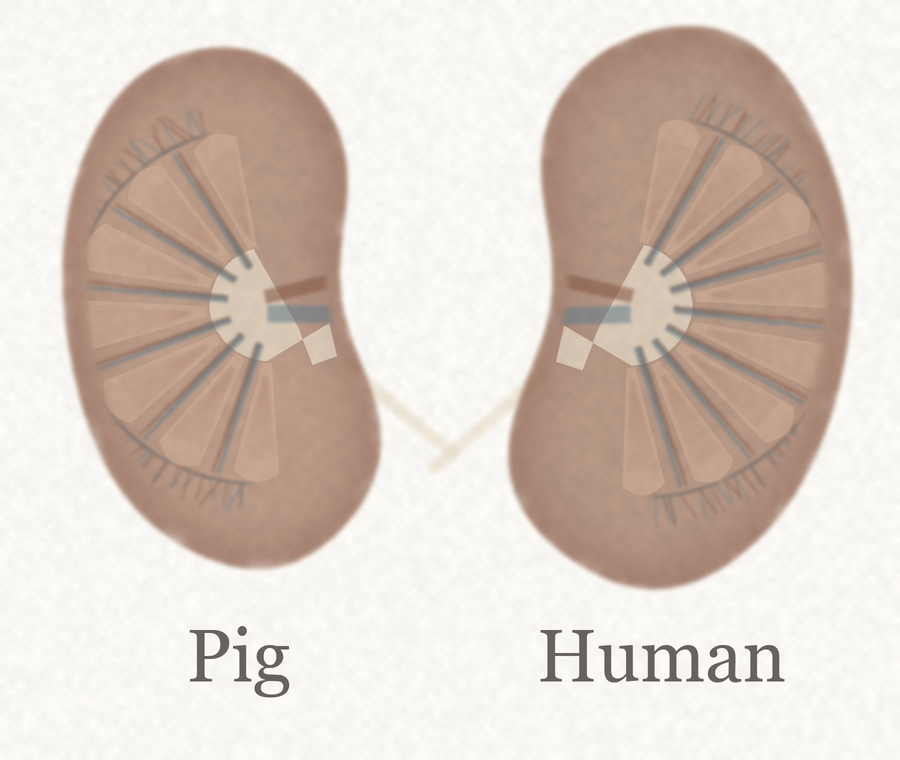
We do not yet know which combination of edits and immune control will deliver durable function. And the number of possible combinations, the search space, is enormous.
Historically, testing a combination meant editing the pig, raising it, transplanting the organ, and waiting months or years to see what happened. That is extremely slow, and it takes many animals.
No one can search a space this large one animal at a time.
Why now
Two things are happening at once. Xenotransplantation, transplanting organs from animals into people, has finally crossed into humans, just as AI is speeding up biological experimentation.
Gene editing can now remove some of the molecular differences that cause the human immune system to attack a pig organ, and add human genes that help protect it. New immunosuppressive strategies can target immune pathways that conventional transplant drugs do not adequately control.
Perfusion technology can keep whole organs alive outside the body. Molecular tools can measure the immune response at single-cell resolution, which was not possible a decade ago.
At the same time, AI has made a different kind of progress possible. Models can now predict the structures of proteins and run large numbers of experiments on a computer, helping scientists decide which edits to make in pig cells. Promising designs can move into whole organs kept alive on perfusion machines. Molecular measurements can show which pathways are being activated and where a design is failing.
Those results become training data for the models, so every experiment makes the next prediction better. That matters because the search space is enormous.
If ten thousand possibilities can become fifty lab experiments, and fifty experiments can become three animals, development gets faster, cheaper, and better. If ten thousand biological experiments can eventually become ten thousand simulations, it changes again entirely.
Measurement closes the loop. The organ's own DNA shed into the bloodstream can flag injury early, and single-cell tools can show which part of the immune system did the damage. A failure that shows exactly what broke points directly toward the next design.
The long-term goal is not simply to make animal experiments faster. It is to need fewer of them, because we can predict more before they happen.
Why this is a longevity question
Look at what actually kills people in a wealthy country, and the same short list of organs comes up again and again. The heart stops pumping, the lungs stop exchanging air, the liver stops clearing toxins, the kidneys stop filtering. Cancer and dementia aside, most people die because one organ reaches the end of its working life and nothing can take its place.
Medicine usually attacks organ failure upstream. Control blood pressure. Treat diabetes. Lower cholesterol. Suppress autoimmunity. Slow fibrosis. That work matters enormously. But once enough tissue has been lost, slowing the process is no longer the same as restoring what is gone.
Replacement attacks the problem from the other end, and it already works. We have a word for it: transplantation. Give a functioning kidney to someone whose own kidneys have failed and, for an appropriate candidate, they live longer and better than they would on dialysis. Its one limitation has always been that every organ had to come from someone who died.
Think of a car. No one expects it to reach the end of its life because the alternator fails. You replace the alternator. A body is not a car. But the analogy is useful in one respect: a system behaves differently when its critical components become replaceable.
If every failing organ can be replaced, organ failure stops setting the length of a life.
Where to start
Kidneys are the natural place to begin. A patient can survive without functioning kidneys because dialysis can temporarily do part of their job. If a kidney transplant fails, the patient can usually return to dialysis. There is no equivalent safety net for a heart, liver, or lung.
That makes the kidney unusually forgiving as the first manufactured solid organ. It also makes the need enormous.
A durable pig kidney would not automatically solve the heart, liver, and lung. Each organ has its own physiology and its own problems. But much of the platform is shared: source-animal engineering, immune control, infection surveillance, manufacturing, monitoring, regulation, and the infrastructure required to deliver an organ safely to a patient.
Solve those problems once and the next organ does not start from zero.
Other researchers are starting elsewhere: growing human organs inside animals, building them from stem cells, repopulating donor scaffolds with new cells, and eventually manufacturing organs from the ground up. Any of these approaches could work. Several probably will.
But xenotransplantation has something none of the others yet does: it has put already-grown, functioning organs into living people and kept them alive. That is why we start there.
The use of pigs also raises a legitimate animal-welfare question. But society already raises and kills pigs at enormous scale for food. If we can make these organs safe and durable, it is difficult to imagine a more consequential use for them.
What the economics look like
The buyer already exists. Since 1972 Medicare has covered kidney failure regardless of age, which makes the federal government the largest payer for organ replacement in the country. It is buying the expensive version.
Medicare spends more than $130 billion, over 24 percent of total spending, on patients with kidney disease, and the National Kidney Foundation warns that untreated progression to kidney failure could bankrupt the Medicare Trust Fund. Every dollar of it buys maintenance, not repair.
Two companies run most of the world's dialysis on roughly $34 billion of combined annual revenue, much of it from government payers.
A kidney alone could carry a price of $500,000 to $1,000,000 in the United States. That price comes from what the alternative costs. Dialysis runs roughly $90,000 per patient per year, every year, for as long as someone survives on it. A decade of that approaches a million dollars, and a durable organ replaces the entire stream.
That price justifies building the whole enterprise now: the R&D, the pathogen-free facilities, the supply chain. Pig organs already work in people, so the core science is derisked, and the economic case no longer waits on a breakthrough.
Whoever produces organs at scale is not selling a therapy for one disease. They are selling the part, for most of the ways people die. Price a durable replacement below the lifetime cost of managing the failure and the math works in every organ market at once.
Today every organ is rationed, because supply cannot grow. Manufacturing dissolves the premise. The question stops being Who gets the kidney? and becomes How do we make enough for everyone who needs one?
What's next
Much of this should start before the biology is solved.
Data. Run experiments that show how human antibodies, complement, and immune cells respond to edited pig cells and to organs on perfusion, measured at single-cell resolution and linked to what happens in the animal or patient. Automate this process as soon as possible. Train AI models on the data until they can accurately predict which edits are necessary and which ones the immune system will ignore. Whoever builds that dataset and model holds the fastest path to a durable organ.
Biologists, engineers, and founders. Build teams and give them the tools that shorten each design cycle: automated editing of pig cell lines, perfusion platforms that test whole organs on the bench, and assays that detect rejection before the organ fails.
Surgeons, and the people who train them. Open more training positions now, because that pipeline may be longer than the biology.
Surgical robots. Develop surgical robots and use AI to train them on thousands of standardized implantations. A manufactured organ has the same anatomy and the same vessels every time, so the operation can be learned, repeated, and automated. Once robots can do it reliably, the number of patients who can be treated stops being limited by the number of transplant surgeons.
Drug developers and immunologists. Build immunosuppression designed for xenotransplants: targeted drugs that block only the pathways a pig organ activates, developed together with the gene edits, so patients no longer need broad, toxic regimens.
Regulators worldwide. Decide now what the approval pathway is for a grown replacement organ, and what counts as evidence of durability when the target is ten years and the trial cannot be. Replace rules for rationing organs with rules that match each patient to the organ design, immune regimen, and timing most likely to last. Shift the policy question from who deserves an organ to which organ will work best in which patient.
Industrial operators. Build the designated-pathogen-free facilities, cold chain, and quality systems. An organ may be biology, but delivering one at scale is a physical supply chain. The end state looks less like a hospital pharmacy and more like a fulfillment network: organs produced at a few central sites, held in inventory, and dispatched on demand to wherever the patient is.
Payers and health systems. Model what happens to costs when a durable organ becomes something you can buy, and do it before the first invoice arrives.
The leap
Most predictions ask you to believe something that has not yet been proven possible. This one rests on something that already has. A pig organ has kept a person alive. What remains is making it last, and growing organs at scale.
You do not have to believe a cell can be made young, or anything about aging at all. You need only believe that a replacement organ that works for months can be made to work for years. That is still hard. It means finding modifications nobody has found yet, and proving they hold for a decade.
A hard leap, but not an impossible one.
The world still treats organ failure as permanent. It is not. Medicine is organized around scarcity. Once replacement becomes easier than repair, all of that reorganizes around abundance.
Replace organs as they wear out, and organ failure stops being a way you die.
We are a group of scientists, AI model builders, doctors, investors, and entrepreneurs exploring ways to pull this reality forward. If you're interested, write to us or send us a note online.